Donate to Africa trip via Paypal here

Showing posts with label food. Show all posts

Tuesday, April 12, 2016

I can see why people want to live here, Chicago

Lots of glass, making sonic canyons for the honking of taxis. Perfect weather, enough snow flurries to keep it interesting but nothing sticking to seep in slushy slop through my silly shoes (I’m Californian, I don’t have the wardrobe for precipitation). The urban rumble of the L train making periodic passes through the air and the ear. All of it was beautiful, all of it was Chicago, but my main memory of the city doesn’t live in the eyes or the ears or the skin.


Just a typical intersection, but I dig the train.
You’d think it would be felt in the feet. My new phone has one of those pedometer things. Is 24,163 good for a day? Downtown Chicago is a walkable city, as long as you don’t mind cars slicing through the crosswalk closer and faster than we West Coasters prefer.


Cars and magic flying schoolbusses both
Walking all day was fine by me, but I had suggestions from some of y’all marvelous folk, so went looking for those. The Art Institute of Chicago was a lovely warren of rooms, where my lady and I found an attendant/guard who agreed with us, John Singer Sargent sure did know his business.


Outside the Art Institute, Chicago's
skyline fading into the morning mist
And I liked the Chicago Cultural Center just fine, with its interior walkways and Eschertastic stairwells, even before one of my lady’s coworkers told me its story. Apparently after the great fire of 1871 burned down the entire city, the French felt so bad about the loss of the great Chicago library that they sent money to rebuild it. The people of Chicago were so grateful that they neglected to tell ze French that they hadn’t had a library in the first place. Sssssh!

Walking incurred a rather windy hunger, which fed my main memory. I hear tales of American food deserts and feel compassionate despair for them and gratitude for living in the Bay Area, but lordy lordy, Chicago ain’t got nothing to complain about. Those folks know how to eat.


So many to choose from, Greek to pizza, barbeque to Bayless’s Mexican, but it was the crepes that snagged my top spot. Because what else would you expect to find under a train station than a French market complete with opulent truffles, Belgian fries, and bona fide French people making crepes at 9:00 in the morning? Merci!


So Chicago was tall buildings, varied art, aesthetic snow, and groaning metal. It was also ham, bacon, eggs, cheddar, cream cheese, and fresh blueberry jam for breakfast, followed hours later by slow-cooked apples, salted caramel, vanilla cream, and toffee chunks for dessert.

Yup, Chicago was pretty sweet.


Tuesday, August 18, 2015

Savory memories from a Malaysian Ramadan

Another bustling day, doing this and that but leaving those these and the other them for tomorrow, and there’s another quick peanut butter & jelly sandwich on my proximal horizon. Wouldn’t it be nice to hop out for quick and delicious food that was interesting, healthy (or at least mostly natural), and cheap? Not fast food, cuz screw that garbage, but… And suddenly the these and those of my To-Do List will have to wait: I’m on mental vacation.

A bowl of spicy laksa soup in Penang, Malaysia
Back to Malaysia, the rampant epicureanism of Penang, with its sweet treats and savory curries, where I sat back with a satisfied sigh, then startled at an approaching obstacle: Ramadan. Eating while backpacking is haphazard at best, and even harder during Ramadan, when restaurants are either closed during the day or tacky to visit. But not in Malaysia, 60% Muslim and 100% food-lovers. Malaysian Ramadan comes with special food markets, for those who are not fasting, or are but want to be ready for iftar, the ceremonial fast-breaking evening meal, usually eaten communally.


In Georgetown I swam among bubbling pots of Mamak (Muslim Indian) food and Nyonya, which blends Malay and Chinese. I remember ayam percik, the marinated chicken grilling over coals in the humid air, chipped bowls of the spicy noodle soup laksa, and the ikan bakar heavily spiced fish I found down by one of the wharves.


In Tanah Rata I stumbled on a market bulging with spiced meat and baked treats, and gestured wordlessly at un-fried spring rolls, little pastry balls filled with sweet paste, and slabs of murtabak, a type of pancake normally stuffed with spiced meat, but I opted for a vegetarian version with potato, egg, and corn, if I remember correctly.

My vegetarian murtabak in Tanah Rata
Many hungry Muslims will buy this delicious food at the markets, but are not allowed to eat it until iftar, so it is pretty callous to dig in when they can’t. This wasn’t much of a problem in heavily touristed and multicultural Penang, and in the Cameron Highlands I could easily sneak off with my treats and find a place with a view of green growing things, but in workaday Kota Bharu I was tormented by the sights in my eyes, the hunger in my stomach, and the desire to not be a tourist a’hole in my brain.

I didn't get a photo of my Buddhist savior, but I did get his
neighbor's squid collection later that night.
Then I found the Buddhist. With smiling eyes over a laughing grin he beckoned me inside the spare restaurant behind his stall, pointed first at the Buddha statue, then at a chair, and finally showed me the little bowl of food that he’d been eating when I walked up. Decadent co-conspirators, we dug into our lunch of rendang daging, a spicy beef dish with ginger, garlic, chilies, and turmeric among the mystery curry mixture. He served it over rice, which he cooked in a woven lattice of palm leaves.

That’s the danger of education via travel: your adjusted perspective will sometimes remind you of how incredibly good you have it… And sometimes it will make a perfectly good PbJ look like a mouthful of blah. I’ll take that double edged sword, as often and as wholeheartedly as I can.

But I’ll meet you at the market.

Friday, July 31, 2015

Playing French, eating like a Bourgondier

Belgians consider themselves quite the lovers of good food and drink. So much so, that they created a term for that side of themselves. Know what they chose? “Burgondiers.” That is, people from Burgundy. France.

If your food and wine are so good that when other people want to exclaim how good their eating is, they compare themselves to you? You’re probably doing something right.


So when I got to Burgundy, arriving through the sort of scenery that could drive an Impressionist into ecstasy and/or insanity, soft green hills supporting sprays of lavender blossoms and tranquil white cows, and learned that those cows are specifically bred and destined to be boeuf bourguignon, I knew what I had to order for dinner that night. You see, it’s a tour guide’s responsibility to know what he’s talking about, and I am determined to pass on that little animal husbandry factoid to tour members for years to come.

But do real life Bourgondiers eat only this apogee of beef stew? Non non non! The meal began, of course, with a small metal plate like a watercolor palette, each of whose half dozen concave niches held an impressively large snail shell. The verdant green of the herb and garlic sauce erupting around each mollusc was delicious to the eyes. Escargot, si vous plaits. Très délicieux!
I could only discipline myself to take this one photo from
the meal, so you'll have to imagine the rest. Je suis desole!

Then came the boeuf bourguignon, so tender and savory that it deserved each and every one of those superfluous letters to ornament its palatial presence on the plate. But was that all? Time to go home? Non! And what was next? Why, fromage of course!

The three wedges of cheese arrived like something out of Greek Mythology. Three sisters of ominous potency, unique in character but sharing origin and essence. They built upon one another’s strength in a potent triumvirate, from the seductive creaminess of the first, through the herbal punch of the second, and into the toe jammy potency of the third. And of course, my wine was tailored to match, because we are civilized creatures.

Normal street detail in Beaune, Burgundy, France
I savored every slith and slythe of cheese on taste bud, and when the plate held only a smear to trace my achievement, my belly felt plump as, well, as a farmhouse cheese. No way I could fit anything else in there.

So it was time for dessert. When it arrived, I looked at the sugared expanse with remorse, knowing I was inadequate to the task. But wait! I was not alone at the table! Two new friends framed my overloaded belly, but alas, one of my mentor’s orientation culture talks mentioned that Europeans do not share food the way Americans do.

“You are always passing your plates around, saying ‘Try this!’ What is that? Why do you do this? No, we don’t do it. You order your own food and you eat it. By yourself.” Suddenly those words were like smoke signals from my rescue ship as it steamed off towards the horizon without me, leaving me lost, abandoned, hopeless in a sea of creme brulee.

But I am not a European. And as an apprentice guide, I am granted a certain amount of leeway. Cultural compromise, if you will. With my mentor’s mercenary help, our two tiny spoons progressed through the wealth of perfectly golden vanilla bean luxuriance.

So the Belgians claim culinary sophistication and epicurean qualification by comparing themselves to Bourgondiers? Yeah, they got that one right.

Tuesday, December 2, 2014

Campeche nights, snakes and ebola

August afternoons in southern Mexico are punishing, but when the sun goes down off the coast of Campeche, the air takes on an apologetic softness to reward you for surviving the broiler hours. As the sky cools down and the streetlamps warm up, the colors shift from baking browns to glowing reds, under a healing blue that lays low above the Plaza de la Independencia, where people have gathered since 1541.

For a few nights I joined that gathering. Food vendors lined the periphery, selling the various corn meal permutations, fresh-caught seafood, and meat marinated in bitter orange and cooked with achiote and habanero peppers, campeche style.

I’d usually start with a tamale, test myself on something spicy, then make sure there was no shark meat in tonight’s brazo de reina (I’ll eat most animals, but those persecuted lords of the deep: no way) before buying a piece, which I’d eat under one of the large and lovely trees.

The cathedral watched over the plaza like a king at his own coronation, fundamental but removed, essential yet somewhat awkward. The stone steps were warm, almost loving, when I sat until ready for buñuelos de aire, the fritters covered with honey that made my fingers stick to my pen, or Muéganos, another fried dough delight, this one covered in piloncillo (cane sugar) syrup. Or there’s always the marzipan made from dried pumpkin seeds...

While I decided which of those best fit the night, I’d watch the locals taking their slow paseos around the park. In the center, a band thumped out traditional music from the spotless gazebo, gazed at by a small flock of kids too old to chase the balloon man, but not quite ready for the nightly soccer tournament.

Young parents pushed toddlers in three-wheelers, chubby little heads turning to follow the progress of the toy vendors, infinite infant attention fixed on the toy horses pulled on thread leashes, and I was impressed to never see a single temper tantrum or hear one wisp of whine. Eventually a flock of bubbles would drift by, and distracted delight would sweep across the wee one’s faces.

Sitting on the outer edge, I was often among the grandparents, abuelitos remembering their own days pushing strollers and cleaning scraped knees. We’d all smile at each other, no need for words. Around us, the summer’s last crop of crickets would crawl and hop across the warm stone, their song mingling with the trumpets and tuba on stage.

Monkey Hostel, travel, backpacking, photos
When I’d had enough, lids and limbs grown heavy, I’d return to the hostel, a colonial residence both dignified and personable, located incredibly right on the corner of the plaza opposite the cathedral. I’d sit in the open balcony door with a cup of tea and watch with the cathedral as the families went home, and the stars took over the music.

It was among my favorite accommodations of all time, inexpensive, clean, replete with character and right in among the authentic local living. It closed two days after I left.

It was 2009, and the Swine Flu craze had already killed most of the competition, this was among the last. I would sit on that balcony, stunned at all the people who had fled from this experience because of a disease they had a sliver’s chance of contracting. Humans are awful at risk assessment, and the news media makes the smoke of a match somehow cloud out the sun.

Travel, backpacking, Campeche nights on the Plaza, Monkey Hostel
Memories of those Campeche nights, and all the people’s memories that didn’t have a chance to happen because of overblown fear, come back to me now as I gear up for a new career in European tourism, hearing with dismay that Americans are traveling less this year due to fear of ebola.

Ebola?!? We’re talking about Amsterdam, Paris, and Rome, not Makeni, Moyamba, and Monrovia. I understand that disease is scary, and I believe we should be supporting the areas with outbreaks and the search for a cure more than we are, but we are a long way from needing to hide in our basements.

(The other fear that is keeping Americans home, ISIS, is overblown beyond belief. Unless you’re planning a trip to Syria, ISIS will never be a factor in your vacation. I believe you’re safer traveling in Europe than you are staying home and commuting with the berserkers who hate their jobs and drive like it.)

The name Campeche comes from Yucatec Mayan Ah-Kin-Pech, which means “Place of snakes and ticks.” Sure, those both exist, just as do ISIS and ebola, but in all my time there I saw neither, and neither will you.

Thursday, August 21, 2014

Food porn, Venezuela style

In the countryside, you can often find nata, the savory
cream topping to the left. No, it's not even close to mayo.
The pupusas of El Salvador clearly made an impression on me, but Venezuela was ready with a rebound relationship. The arepa is the traditional and quintessential food item of Venezuela and Colombia, dating back to precolonial times, when it was made by the indigenous tribes of the area whose word, erepa, it (basically) still bears.

A friend had expressed concern that shortages of arepa flour might prevent me from finding them, but luckily that was not a problem. However, we did hear tales of scarcity, similar to what you'd hear if China ran out of rice, America ran out of oil, or Brazil ran out of sex.

Ham and cheese arepa for breakfast,
and unfortunately too dark to see the
one in the back, because I can't
remember what it was.
Arepas are pretty much just corn meal patties, with none of nixtamal's alkaline processing (and ergo less nutritious than pupusas), though yucca and wheat varieties are also skulking around the region. Plain arepas are served with most meals, like bread in Italy or tortillas in Mexico, but they are commonly a stand alone breakfast or afternoon snack. If they're the star of the show, they can be fried, stuffed, or stacked with a variety of ingredients.

The basic breakfast incarnations select among cheese, beans, and egg, though shrimp, chicken, pork, beef, coconut, and avocado were usually available too. That list is deceptively short, since “cheese” can take any of a dozen forms, while pork, chicken, and beef also come in multiple preparations, my favorite being pernil, a pulled pork usually made from the shoulder.

My domino sample, with avena. I would
have taken a pic after I started eating,
but it was drippy lava-hot goodness.
Three other favorites are dominó, reina pepiada, and pabellon criollo. The first of those is just a mixture of black beans and cheese that went well with a glass of avena, a thick oat-based drink cinnamon, clove, and sugar, that reminded me of horchata's chewier cousin.

Reina pepiada is a traditional Venezuelan filling of chicken and avocado, in a sauce that may contain mayonnaise, lime, and cilantro. It's frickin delicious.

Then there's pabellón criollo. You can stuff a sample of this dish into an arepa, but I had it as a separate plate, and it was the single best meal I had in Venezuela. Traditionally a farmer's hearty breakfast, I did indeed feel capable of working for hours after eating it...as long as I (miraculously) avoided the food coma.

There are of course variations, but I only have eyes for what I ate.

Nostalgia rarely includes so much drooling.
-Rice, and caraotas fritas. I use the local term since if I just said “fried black beans” you might not picture the savory deliciousness that found its way into most forkloads. So good.
-A fried egg on top of the beans, cuz why not?
-Carne mechada is a shredded beef preparation similar to Cuba's ropa vieja that paired perfectly with the caraotas, and made me eager to find a field to plow. I felt like Venezuelan Popeye. I bet there was coriander in there.
-Tajadas. Again, “fried plantains” just doesn't do it justice. Nor adequately pay homage to the way these ingredients blended, cooperated, and tag-teamed my taste buds into blissful submission.

It was all so good, I nearly forgot about the fresh parchita (passionfruit) juice and basket full of arepas.

There is still a special place in my heart for pupusas, but after a Venezuelan meal, there was no spare space in my stomach.


Thursday, August 7, 2014

A battalion of sauces, lots of boobs, and sheer normalcy on the streets of Caracas.

(In deference to the blogosphere’s reverence for brevity, I split this post in two; the first half is here)

After clearing customs, hearing of youthful harlots, and being warned that the water is shut off at 8:30 PM every night, I was released to wander the streets of Caracas, a city endorsed by voices familial and journalistic as being utterly unsafe. “Walk those streets, and you’ll be kidnapped, shot, or worse” seemed to be the consensus.

My first task was a haircut. That completed (blog to follow), I set my steps to witness the city. I'd left as many expectations and preconceptions as possible at home, and tried to see it with open eyes. What did I see?

Normal people wearing normal clothes walked normal streets past normal stores selling normal things. Familiar billboards used the same idiotic pressures and messaging to sell junk, and the noise level was generally...normal. People smiled back when I smiled first, nobody seemed angry or in a particular hurry, and no pedestrians were being run over, nor abducted into unmarked SUVs.

All in all, it was a lot like most cities.

There had to be something different, after all, Venezuela is not a routine nation. There was more propaganda and political dialogue than I'm used to, but not so different from, for example, Nicaragua, and less than any country during election season. This, despite the surprising fact that there was indeed a minor election that weekend. 

(The tags on this wall read: "It's not about Left or Right, it's about human dignity", "The people are the power", and the iconic eyes belong to Chavez, listed along with a lamenting cry to Nicolas Maduro, the current president and Chavez's successor, listing things he sees, including scarcity, torture, corruption, and violence. But the most striking to me is the one in the middle, which reads "There is no milk, only bullets" and is an infant nursing from the barrel of a handgun.)

Perhaps the most noteworthy difference? There was an unnatural incidence of giant boobs. Plastic surgery is insanely popular in Venezuela's capital, and the cleavage was on patrol.

(Yawn.)

I meandered through the crowd, took a few pictures, got lost for a while, and surveyed for what I would eat. The answer seemed clear; the answer seemed...normal.

The one where I ate had no chairs and even more sauces.
Food carts stood at regular intervals on Avenida Francisco de Miranda, one of the city's main thoroughfares. Depending on the size of the cart, one-to-three cooks sauteed, fried, and assembled portable meals for a steady stream of customers, most of whom stood in front of the cart, helping themselves to liberal quantities from the armada of sauces waiting there. Ketchup, mustard, mayo, barbeque, and ranks of mystery bottles stood ready to dollop, squeeze, and squirt onto sandwiches, burgers, or whatever one had in hand.

A burger just didn't seem appropriate, so I asked for an enrollado, which was basically a burrito, filled with quality chicken meat, tomato, avocado, alfalfa sprouts, and I don't know what all else. Some sort of sauce that tasted almost....Chinese? It was good, though I can’t imagine drowning its already drippy depths with surplus sauce.

I went looking for a big bottle of water to wash it down and get me through the dry night, but it was Caracas after all, and all the stores were out, or had only tiny ones. I grabbed two of those from a bored dude in a kiosk, and looked around to decide what direction to go, as the light faded. “The Blue Hour” is a photographer's favorite, and I wanted to find the right place. Photography time!

Turns out the water shortage wasn't the only thing to differentiate this city. As the light disappeared, so did 95% of the people on the street. Suddenly there were large open spaces, and a lot of young men looking at me. Taking out the camera didn't seem like such a great idea anymore.

Hm. Listen to Them, and head in? Listen to my experience that warnings are always overstated? A voice whispered that the most interesting things happen during the “forbidden” times... But another topic of emotional conversation on the cab ride in from the airport had been the utter impunity of criminals in the city. No one was sure what the exact figures were for kidnappings and ransoms, but estimates competed to reach the ceiling.

When in doubt, do as the locals do, which in this case meant abandoning the street. Getting flash kidnapped might make a good story, but would totally ruin the experience for the four other women in the group.

My unremarkable hotel room. Pretty clean (other than the
hair that came pre-installed on the pillows and sheets).
Back in my room, susurrations of the city leaked in through my poorly-fitting window, and a soundtrack for self doubt. Would a balsier traveler, a more audacious writer, have stayed out? Gotten some amazing story that was now slipping by, unseen by my eye? Or would that have just been stupid? Eyelids like sandbags at 8:00, I pondered the question as I went to the bathroom, preparatory to brushing my teeth and going to bed.

The toilet didn't flush.

All advice considered, if that was the extent of my misfortune... I'd take it. And be ready to witness the next day.

Saturday, July 26, 2014

What does "authentic" mean? And pupusas!

I was still in love with El Cielito Lindo, but on my last day in Ataco I had to obey the part of my Traveler’s Creed that demands to try as many new things and places as possible, so when I found another pupuseria tucked into the porch/courtyard of a house on the other edge of town, I waited until their single table was free, then went in.

A typical pupuseria I went to in San
Salvador. The yellow bowl is curtido.
This place was a contrast to El Cielito. Instead of the solid wood furniture topped with a local burlap sack, they had the sort of one-piece plastic table-and-bench with a chipped yellow plastic top that you’d find in the bargain taqueria/burger/Chinese/kebab/noodle shop across from the bus station.

There was no menu, the large woman with the spatula just asked if I wanted cheese or pork, and the beverage options were coke or beer. She turned to the table opposite the grill, lifted a fly-speckled towel, and continued hacking apart a chicken for her family’s almuerzo. When she finished the bird, she reached down with shiny fingers and grabbed my coke.

An old dog slept under the grill, a toddler wandered around without pants on, and an older man was spreading grout with a trowel for the heavy paving stones stacked next to my table.

This place wouldn’t make it into the guidebooks.

But the people who’d been at the table before me were pure Salvadoreños, two men on their way home who leaned their well-worn machetes against the wall while they ate. Cielito had enough tables to accommodate an entire busload of visitors, while this place had one table next to the grill.

It was scrupulously clean (other than the salmonella) and without any detail or decoration that might smack of deliberate “Salvadoranness”. Suddenly the burlap tablecloths in El Cielito looked a tad contrived. Still local, still recycled/repurposed, and still aesthetically pleasing, but contrived.

“Authentic” is a problematic word. We all go looking for it, but what does it mean? The horchata I had at Cielito is a traditional drink of this area, specific to the region, and beloved of the populace...who normally drink coke.

So which drink is more “authentic”?
Hint: if the menu has "typical Salvadoran food" on it,
for $11 (when the table-groaning load of food in the
first pic was about $2.50) it's probably not authentic

Cielito’s ample menu of options was impressive, and spanned a variety of ingredients that are absolutely used every day by Salvadoran people...but most places offer the Big Three, only. Which is more authentic?

The good thing, the bad thing, the entertaining and eternally interesting thing, is that it’s up to every individual to decide, every individual time they do any individual act. One day, Cielito’s wide breadth of native ingredients might sing true, while the next, only a familiar three-option pupuseria will do.

Where would you like to eat tonight?

Wednesday, July 23, 2014

A beautiful little heaven. And pupusas!

A Beautiful Little Heaven… What could be better? How about when it has delicious food and drinks.

I spend a disturbingly large portion of my time abroad searching for my next meal. Maybe it’s a consequence of growing up in the bizarre food surplus of the Bay Area (quote from last night: “What, they’re closed? But it’s not even 10:30 yet, and I want gelato! Fine, let’s go to the 24-hour artisanal doughnut shop around the corner.”) or one too many dinners of squished granola bar dug out of the bottom of my bag, but when I find a good place to eat in a foreign town, it tends to anchor my mental map of the place.

So as far as I was concerned, El Cielito Lindo was the hub of Ataco, a small town of whitewash and vivid murals where women carried trays of fresh bread on their heads, in the highlands of El Salvador.

As in much of Latin America, much of the world really, lunch is the main meal in El Salvador, while breakfast and dinner are simpler and smaller. I know that’s healthier, and I know I need to adapt to the culture of the location, but...my day just doesn’t feel complete without a warm dinner. So when I walked the absurdly clean stone streets of Ataco and found the colorful pupuseria, I had to try it, even though it was a little late in the day, the sky already given over to violet and the last bars of birdsong.

The national food of El Salvador, pupusas are kind of a cornmeal pancake/tortilla filled with a variety of ingredients, the most common of which are cheese, refried beans, and shredded pork. They are similar to Colombia’s arepas, except while those use ordinary corn dough (and don’t always have filling), pupusas use nixtamal, which is cornmeal treated with an alkaline solution that helps peel the grains, accessing additional nutrients.

Not impressed yet? That process has been going on in this area for thousands of years. In Joya de Cerén, a village of the Pipil people that was buried by volcanic ash 2,000 years ago, they found the implements for making pupusas. Pompei didn’t have pupusas. I’m just saying.
No, it's not normal to have that many options.
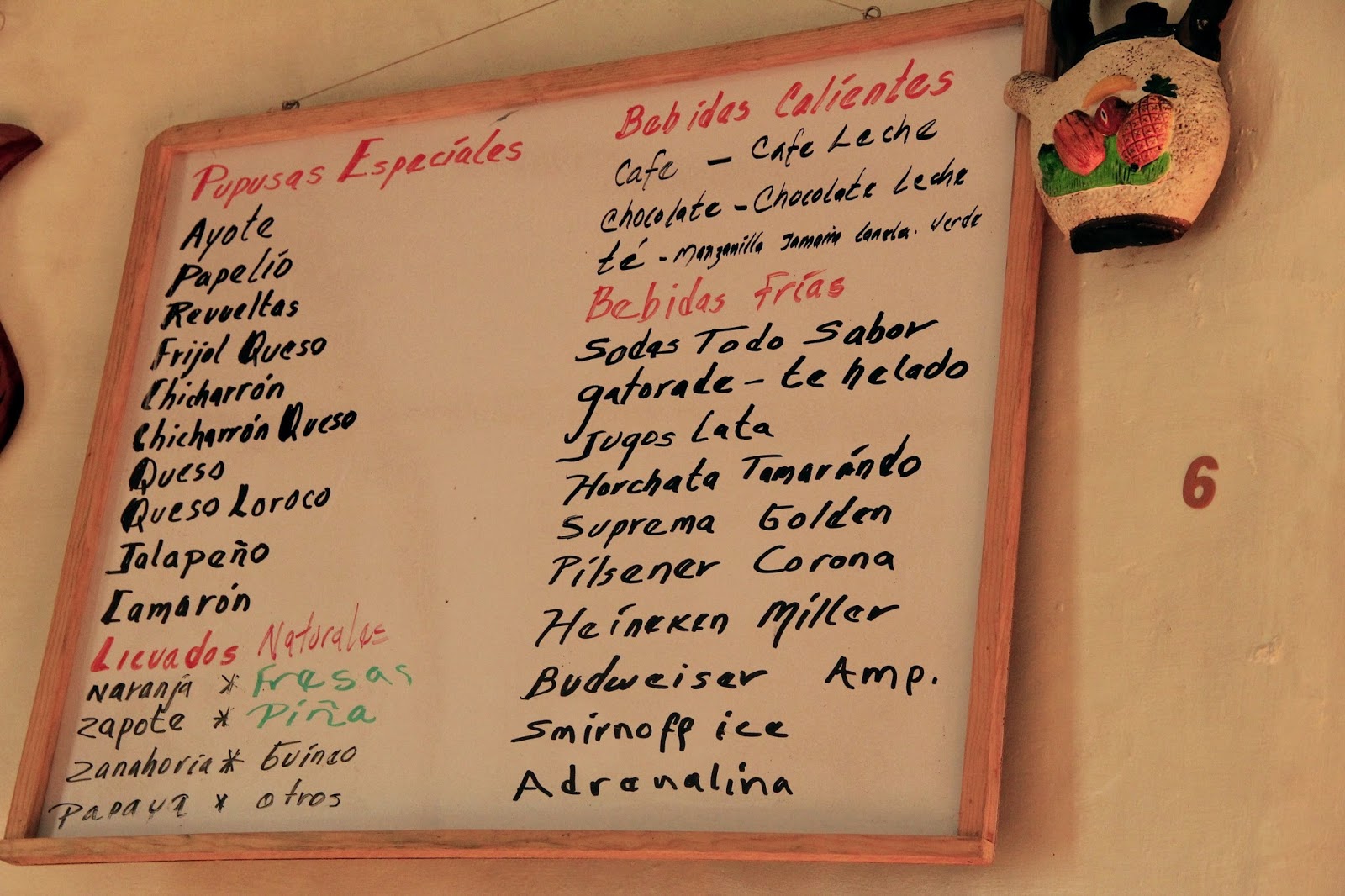
I sat at a solid wood table covered with the burlap sack of a local coffee grower and looked up at Cielito’s menu. Cheese, beans, and pork may be the normal fillings, but Cielito doesn’t stop there. They had every permutation of the three classics, plus jalapeño, prawn, and three things I’d never heard of.

I ordered one each of the unknowns, plus an horchata.

I’ve been drinking horchata for over twenty years, and love the sweet flavor of vanilla and cinnamon, but that was not what arrived in a tall glass. Every horchata I’d ever seen was white, unsurprising since it was made from rice. But this? This was brown. And the flavor…

I am not good at identifying ingredients, comically bad in fact, but something in this drink’s ancestry made sweet love with brown sugar. There was none of the starchy smoothness of rice, instead a deeper, nuttier flavor, with a subtle current of something almost...fruity?

But just like (what I now think of as) “Mexican” horchata, this Salvadoran stuff hit the tongue with so much sweetness you thought you wouldn’t want more. But then a second later...gimme more!

Then the pupusas arrived. The matron of the place, Mauda, left her telenovela to bring me a plate of steaming nixtamal pupusas with queso de loroco, ayote, and papelío. I tried to wait until they wouldn’t burn my fingers, but couldn’t hold back.

Loroco is an edible flower, and the cheese made with it had a much stronger flavor than most of the savory white cheeses of Latin America. Kinda like a gamey feta? It made for an interesting change of pace.

Ayote is a type of squash similar to a pumpkin, and they use the whole plant: flowers, stems, and shoots in addition to the fruit. It was a fairly subtle flavor, which I prefered to the loroco.

My hands were full of food, not camera
 but this dude I met in Guatemala
could have been his brother.
Papelío. I had no idea what this was, and l’internet now informs me that it’s a type of butterfly. Odds I ate butterfly? Not good, I’m guessing it’s a more poetic naming, but I have no idea what it was. But it was, unsurprisingly, delicious.

The pupusas were, of course, served with curtido, the customary tangy cabbage slaw made with vinegar and chili peppers, that is lightly fermented. Pupusas steaming on the plate, horchata in hand, I was smiling when the youngster walked by, saw me, and stopped mid-sentence to stare at me, somehow shyly.

I wasn’t the first tourist he’d seen, not by a longshot, but there are still not so many of us there as to be boring, and he giggled when I made a face at him and winked.

Delicious pupusas burning my fingers, new drink cooling my tongue, telenovelas and animated conversations bouncing around my ears, beautiful Salvadoran town to explore, and now this little dude’s laughter to top it all off?

This is why I love travel.