Donate to Africa trip via Paypal here

Showing posts with label Panama. Show all posts

Tuesday, April 5, 2016

Panama papered with money

Panama is a transitory sort of place, a door of sand and rebar where Pacific pressures seek Atlantic relief, South American impetus touches North American markets, and the West Indies just want to finally find the Orient. And my first time there, it was a clanging casino where women with little clothing looked for men who wanted to see them with even less.

The woman I was with had substantially more clothing on, and was just looking to withdraw some cash. (I assure you, we were entirely platonic.) We hoped to be co-passengers on a boat to Colombia, and finding a place for a cash advance in Panama City was harder than you’d think. Our local friend’s advice was to try the casino.

Where do people want money more urgently than in a casino? And where else is there the kind of security that ensures they’ll have money on hand, and that you’ll get to keep it when they give it to you?

While she concentrated on paper forms, I peered at the lifeforms.

In the main room sprawled a crowd of retired, wealthy, and vaguely confused men who looked like they were having fun. But for the withdrawal, we had to go into a higher roller’s room, where the few specimens were quiet, young, and determined to look like movie tough guys. (The lights aren’t that bright, bro, you probably don’t need to wear those thousand-dollar sunglasses. And not much need for a poker face when you’re playing blackjack.) They didn’t look like they were having fun. Too Jason Statham-faced.

“This town is so full of crooks” sighed our local friend. “None of these boys pays taxes. Well, none of these boys work, but their papi’s don’t pay taxes.”

I thought of all the Cayman Island flags I’d seen brazenly displayed on luxury yachts over the years, taunting the taxpayers, and was unsurprised.

“Panama City has long been where corrupt politicians come after they get kicked out of their countries, and they bring their treasuries with them. We’ve got lots of first-class pendejos here.” She added. “But now we get all sorts of shady businessmen too. Okay, ready to go?”

I was, and we did (and the days on the boat were magnificent). But that image, glittering rich people who refuse to pay back to the societies that made them wealthy, came to mind this week when I read about the Panama Papers.

Are they surprising? Not remotely. Are they important, as an opportunity to change this system? Absolutely. I for one am hoping to see something come about from this, beyond forcing the Icelandic Prime Minister to resign.

Friday, October 17, 2014

Hemoglobin, non-terrorism, and adorable despite a little racism; in Panama City

Arterial roadways and Panama City
I was a happy little red blood cell. Biding my time before entering the veins of Venezuela, I was promenading through the pulse of Panama, crossing arterial roadways to meander beside the lymphatic mud flats of the capital’s southern, maybe eastern, western-ocean-facing harbor. It’s a tidal maelstrom of a place, Panama City. Currents of South America hit the breakwater of Northern dominance, while the West Indies just try to get through to reach the Orient.


"A great friend of Panama"
statue was downtown until
it was damaged in a protest.
And I was just another particle, a nutrient perhaps, life-giving at best, parasitic in the end, and enjoying the ride in the meantime. Franklin Delano Roosevelt surprised me, baptized in pigeon shit, cracked by revolution, and now exiled by urban planners to a scenic and irrelevant perch between oncoming and outgoing traffic.

The floatable tools of tenuous livelihoods were stranded in the muck of low-tide, pretty and hideous, colorful and infinitely drab, appealing to my eye but forbidden to my camera in this post 9/11 world, where armed guards were too bored to acknowledge me, but their supervisor, obliged by rank, called me back from lens distance. “Why are you taking pictures of the harbor?”

Panama City harbor at low tide
“Cuz it’s pretty.” Did not satisfy him. So I pointed out the circles of oil drums against the linear wanderings of boat hulls, the prehistoric muck of the ages patiently reclaiming the trappings of modern conceit, the camaraderie of hulls at rest.

He waved me away. A nearby Rastafarian found the show hilarious, and called me over. His skunky smell and laugh-lined eyes made me feel at home, though most of his words were unintelligible. I’m pretty sure we agreed that nowadays people take themselves too seriously. He’s my friend.

Playground they were ignoring
It was too early in the trip for loneliness; I was still lubricated by the renewed flow of travel vivacity in my veins, jolly in my joints, melancholy unable to find a place to oxidize. This made it easy to dance with the kids, finding joy for themselves aside from the paternal provisions of playground planners. These kids had too much swing in their steps to need swingsets for their butts.

“Hello!” They cried like seagulls as I approached. “Hello! Hello!” Then in the precision of classroom lessons transferred to the real world, word by word, they added “Where. Are. You from?” Laughter as punctuation.

My Panamanian pals of the promenade
I answered, and as politeness decrees, returned the question. “We are PanameƱos!” replied a big voice from a small body. “Except him” and a tiny finger pointed to the boy in the blue shirt. “He is African.”

A glance at the face above the stylish blue collar showed this was not true, was not welcome, was another incidence of the scraping search for understanding of childhood, accidentally abrasive, sharp with the latent racism of Latin America. The boy in blue hid most of his reaction well. It’s probably not the first time.

What do you say? How do you push back, perhaps instruct, be a nutrient and not a parasite? Tiny feet were ready to run off again, my seconds clicking short. “I’m African too” was my best try. This paused their feet. Is the gringo crazy?

“I am African. So are you. We all came from Africa.” I’d neglected to pack my notes on the migration patterns of early humans, but I dare to remember a slight smile on a darker skinned face, and there was no malice in the laughter of any.
They held the pose for 1/32nd of a second

Besides, more important concerns were on hand. Namely, a request for a co-photo so vulnerable, so tender and murmured that it very nearly broke me with its innocence.

Race relations, cultural exchange, personal evolution. Nascent love. We’re all doing the best we can, for ourselves and for each other.

What would you have said, in the face of a child’s unhateful brushes with the legacy of inequality?

Monday, November 25, 2013

Lunch vacation

Today is cold feet and hot cups of tea. Now sit down and be productive, damnit. Sunlight is tapping on my window, impatient for me to finish this healthcare website business, a bicycle ride in the planning, but the unsatisfactory numbers blur together and my hypothermic fingers nudge the mouse button more than click it, knuckles gone stiff in the chill, so wouldn't you know it, it's time for another cup of tea. Extra long pause to pet the smiling dog this time.

This feels like choosing which demon to feed my blood to, is there such a thing as a good insurance company? Do I give them too short of shrift? Perhaps it's just scar tissue from a high school job in a pharmacy, helpless before the confusion on the faces of the elderly, who got sick after years of paying premiums, then their insurance companies dumped them. “Can they do that? I guess so.”

Maybe the Affordable Care Act, embarrassing baby step that it is, will clear some of that.

Ug. This shit is enough to send me back for more tea. I'm going to die of hyperhydration. Is that covered? Time for a vacation. Right now.

A few sluggish pushes on the mouse, and here I am in Panama, the San Blas Archipelago. I've forgotten what socks are. “Sweater” is a noun to describe me, not an article of clothing. Why would you ever need more than a T-shirt? Warm water is right there, whenever you're ready, and again next time.

The Argentinians are drinking their mate, and the Venezuelan barters for more lobster from the men in the canoe, who laugh at his antics. Our game of rummy will last for hours, one hand every ten minutes, broken by dolphin breaks when dorsal fins appear within the lagoon. I'm the only one who swims there fast enough to see them, and my remorse at this is subsumed by a warm Caribbean soak that suffuses the salt with gratitude.

In a few days I'll disembark in Colombia, and my pack is lightened by a load of blissful ignorance, foolish belief that I have it all together, my secret manageable. It feels like helium, but is more akin to carbon monoxide. But for now, the world is laughing with me in sunlight refractions and pineapple fingertips.

I feel better. Now...what size deductible can I handle?


Tuesday, October 1, 2013

Is it weird being back in America?

Is it weird being back in America?

I wasn't sure how to answer that question. “Not...really.” Adjusting to Stateside norms was pretty easy; I did grow up here, after all. I can handle silverware and I never picked up on the whole spitting thing anyway. But as the last month has passed I've noticed a couple ways in which I am still adjusting after all.

Trishaw drivers know better than anyone how to survive
in the traffic in Yangon, Myanmar
Number One: crossing the street. In 90% of the world, as far as I can tell, moving around on the street is based on the principle of not making any sudden moves or changes of direction. If you can estimate everyone else's trajectory, you can move around them.

To cross the street overseas: start walking into traffic, not fast, not slow, no sharp directional adjustments. If possible, walk straight at the back of a passing car. It will continue moving, so when you reach it you will slide right into the space it just vacated. Continue this until you've Froggered your way across the street.

It's similar to the way you don't try to avoid the cockroaches, just trust that they'll avoid you.

But in America, if you do this, all the cars on the street do something extremely unexpected in the global mind: they stop. Or at least, they slow down and wave you across. Now, instead of sliding unobtrusively through traffic, you are blocking it. Dangit, Americans, stop being so polite!

So I have had to go back to obeying formal traffic rules. It's weird.


One need not make plans in the San Blas Archipelago
Number Two: I rarely planned anything more than a day or two in advance for the past few years. I would reach a town and stay there until I was done, during which time I'd hear about some other place within a six/seven hour bus ride. Go. I am not an itinerary sort of guy. But here, this means I don't get out much, since everyone else has social calendars booked weeks in advance.

Me: “Hey, you wanna do something?”
Friend: “Sure! Let's get sushi! When works for you?”
Me: “How about tonight?”
Friend: “I'm booked until January.”

I gotta get the hang of that. Anyone want to go get sushi...in January?


Does this dude in Kuala Lumpur seem worried about his image?
And finally, there's Image. I've made a career out of trying to resist this, probably as a means of coping with my lack of fashion passion (as my closet of blank-ass clothes will attest), but my skills were were honed overseas. In Nicaragua they described my sandals as “Jesus shoes” and I kept wearing them. In Sri Lanka I sewed up the entire left side of my shorts with the wrong color thread and thought no more about it. In Myanmar I could not have cared less when it was a woman's style bicycle I rode.

You can't be too picky about your image if you get your hair
cut in a saloon. Can I get a sarsaparilla with this perm?
I brought that all home with me. The friend moving out of my new room offered to loan me her woman's style bike and I accepted, no worries, who cares if people think I look silly? It's a bike. That ended up not working out, so I have my manly man ride after all, but whatever, it's shruggalicious.

And I had to smile in the grocery store as I bought a big bag of toilet paper, thinking about how poop-phobic Americans are, and remembering confessions of people who were humiliated to buy the stuff. “I buy it at Cosco in gigantic packs so that I don't have to do it very often.” Whatever! I'm not embarrassed by anything!

Can you guess what these Pa-O kids in a mountain village
in Myanmar think of our image concerns and poop-phobia?
But on the walk home, toilet paper casually under my arm on the busy street, I saw a bag of clothes hangers on the sidewalk. I inherited four hangers with the closet, but I now had seven shirts, with premonitions of more to come. I needed hangers. And here was a bag full of them, free on the sidewalk. We're also an intensely germaphobic nation, but the odds these hangers were actually infected and infested, scabies, hepatitis, bed bugs? Very slight.

But I walked right on past. What would people think if I was rummaging through the garbage on the street?

Oh.
Damn. That's disappointing.


It's weird being back in America.

Wednesday, May 30, 2012

Making it to Cartagena

Rudy is a fan of dawn departures, so as the sun rose we were pointed towards Colombia, engines humming, relentless and calm. The crossing would take a day and a half, most of it out of sight of land.

Open ocean. The waves weren't that bad, but as they approached the prow I understood the phrase "wall of water" better, and was surprised again and again when our hulls lifted effortlessly over what had a moment before looked like a monster about to swamp us. The motion was enough to prevent things like reading or being inside, and leaving poor Jamila without appetite by the time she finished making food each evening in the stuffy galley. We spent one dinner watching Rudy hold her around the waist as she leaned overboard to lose her lunch. She recovered with impressive speed and the Spanish (language) torrent commenced anew.

There’s really not much to do on a heaving ship, and people tended to fall asleep in random locations. Rudy and Jamila often stretched out in the main mess room (which we never used for anything else) while us passengers could be found in the stern or on deck, sun permitting. My main periods of excitement were clinging on the back of the heaving ship to wizz into the sea.

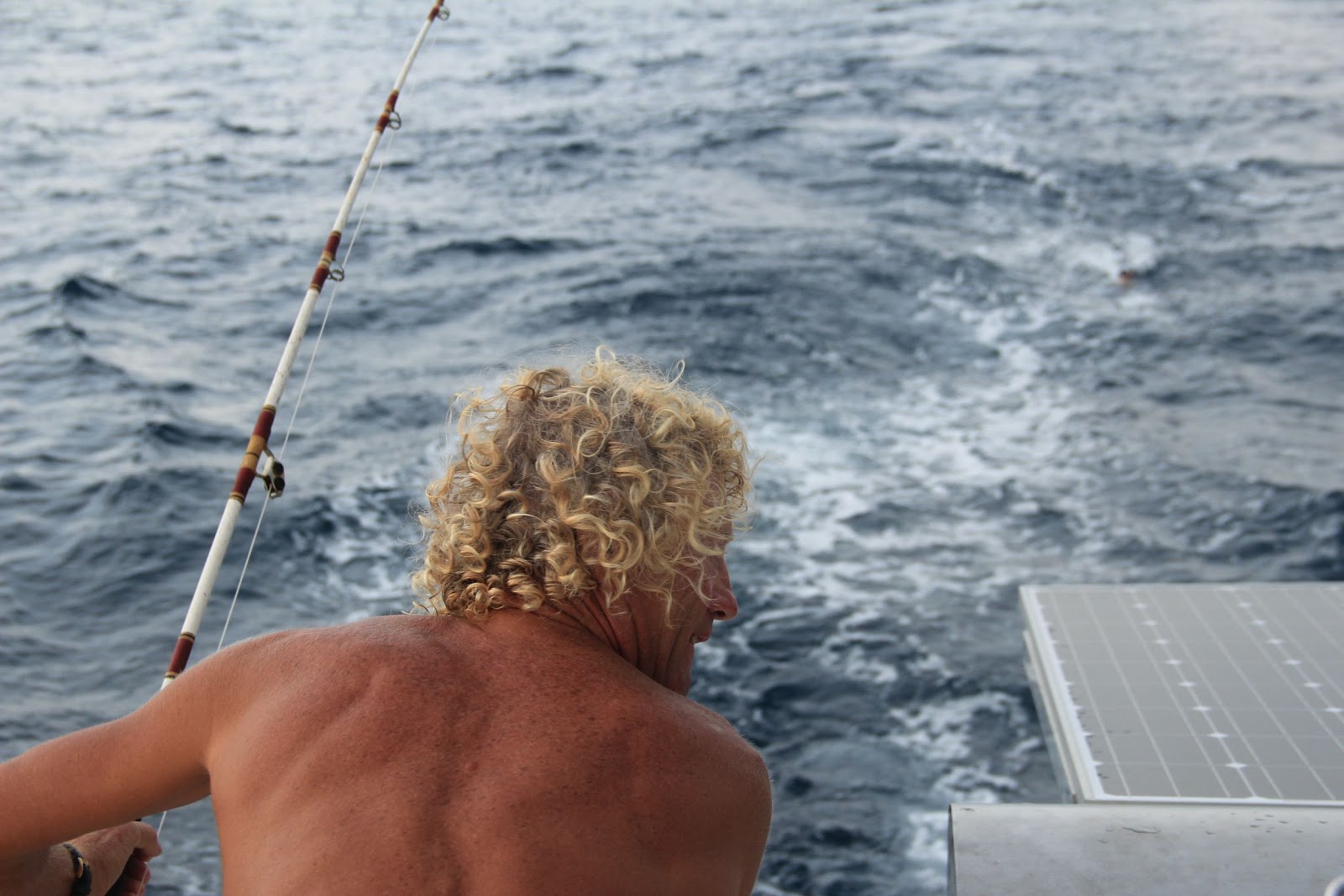
We almost caught one large silver streak of pelagic fish ferocity, but it escaped with about two meters to go. Rudy looked like he needed a hug. Imagining what it must take for a fish to get off a hook like that…I wondered if it should have just come onboard. Poor fishy. I hope they have good oral surgeons down there. (Oral sturgeons? Ichthydontists?)

That night we all took turns standing watch for oncoming boats. I sat in each of the twinned white plastic fishing/captain’s chairs in turn, peering occasionally into the impenetrable darkness in front of us, but mostly watching the stars overhead and listening to the waves passing around and beneath us, occasional slaps against the catamaran’s hull. There were sparkles of bioluminescence in our wake throughout the whole night and I let my two hour shift drift into three.

It felt like a very romantic date with Poseidon.

Sunset at sea.
I sat in the stillness, feeling like I was approaching a whole new planet. South America! A new continent. The impending weight of all those places to see, people to meet, and memories to form was like...well, there's nothing quite like it. Each invisible nautical mile was bringing me closer to a whole new touch of life.

By the following afternoon I was impatient for the continent, and generally pretty dang ready for solid ground again, and was pleased to see the skyscrapers of Cartagena on the horizon.

Jamila apparently was too, as she started cheering and clapping from where she was sitting at the bow. I was surprised at her enthusiasm until I realized she was shouting “bravo!” to the 6 or 7 dolphins who had arrived (literally) out of the blue to play in the modest bow crest of a catamaran. Not sure if it was her acclaim or not, but they stayed with us for a good long while, even Rudy’s reticent seaman’s face opening in broad smiles and laughter. Those animals are joy incarnate.

It takes awhile to reach the horizon when you’re chugging along at 6.5 knots, but finally we were pulling into Cartagena. Giant freighters glided out to sea on one side while power boats douche-bagged around the harbor mouth on the other. A line of tall glassy skyscrapers stretched impressively far down the coast, none of them a staid square, all instead sporting curves, angles, and frills.

“Like Miami, but smaller” was Jamila’s observation.

We pulled into Bocagrande, the yacht harbor area, past a statue of the Virgin Mary waiting in salty patience for her festival day of the year, and parked among the other yachts, our German flag comfortable amidst those of America, Canada, France, Switzerland, a couple Scandinavian crosses (who can remember which is which?), and my own personal least favorite, the Cayman Islands.

I don’t understand how anyone can bear to fly that flag. It is basically shouting “Hey everyone! I got rich in a system built by our forefathers, and I ain’t paying shit back into it! Suck it!”

Oh well. I shouldered my bag and headed into Colombia, looking for nonseafood, a shower, and stationary earth.

Tuesday, May 29, 2012

Andiamo a la African Queen


The Cartagena heat melted all my words, which ran down in an inky slide into the off-gray mattress, perplexing the mosquitoes along the way, but here I sit in Bogota, the next chapter beginning tonight...so I gotta get this ship to harbor, as it were.

Definitely no booze cruise, but there
are always bottles on board.
After my dolphinous morning swim in Chichime we spent a languorous morning doing very little on the Andiamo, the Spettiamo, before sailing to another island, where a Kuna in a palm frond hut was happy to sell us cold beer. Most of the islands have nothing on them, or just a few huts, but the ships know each and every stretch of sand with a bar.

All 5 of us wanted to explore the new island, but there was only room for 4 in the dinghy so I happily volunteered to swim instead. At first I enjoyed pushing a little, but man, that swimming stuff is hard, so I latched on and rode the last part to shore like a barnacle, gazing down through shallow water filled with the fragile remains of sea urchins and sand dollars, sea grass growing up through sand like mud in the still water.


Adios Andiamo!
Fabio finally reached the captain of my next ship, the African Queen, and we set up a rendezvous point. We motored a little farther down the island chain and just before sunset the African Queen glided in from the horizon, a gleaming white catamaran flying the flags of Panama and Germany. I rowed over with Fabio as my shipmates sat on the deck of the Andiamo waving farewell.

It felt really weird to be on the new ship, new people, with my old companions lined up opposite watching and occasionally shouting remarks. Like switching high schools your sophomore year, only the new one is across the street. I tried to find ways to say “don’t worry, I’m sure you’re nice, I will like you too” to my new shipmates.
Rudy looking positively captainy.

My new captain was Rudy, an Italian (who apparently has a business in Germany?), assisted by Jamila his Colombian…something. Not girlfriend…not mistress…but not just staff either. Whatever. Rudy has that taciturn likeability like a calm gravitational pull, and Jamila provided all the energy and enthusiasm we could ask for with her (what I would come to learn is distinctly Colombian) machine-gun speech pacing, with nasal overtones and enthusiasm eruptions. Colombians are a people always primed to laugh.

The other passengers were Steve and Brett, and Australian father and son. One of the first things Steve told me about was his obsession with torches. This got slightly less weird when I realized he meant flashlights, not Medieval flamesticks, but still. I thought he was kidding at first, but no, he talked about flashlights regularly, and seemed to have brought at least four with him.
Steve examining lunch

His son Brett was somewhat press ganged into this enthusiasm. Whenever he’d use his own (admittedly excellent) flashlight Steve would say “thet’s a nayce loit ye got there Brit, where’dya geddit? How miny lumens duzzit hiv?”

Brett’s own positive attitude was nearly unshakable, only giving a slight ripple once when his vegetarian meal was clearly lacking, while the rest of us munched grilled lobster audibly and kinetically in front of him. He also managed to walk a perfect line between super-chill and flamboyantly gay.
Jamila's not so sure.

We spent the night alongside the Andiamo, including some tension when the current shifted and we found ourselves floating dangerously close together. The next morning the Queen was up and gone by 6:00, a lone hand on the Andiamo waving farewell from where the crew slept in the stern.

First we headed to Porvenir, an unlovely little city-island where I got my Panamanian exit stamp in a time-honored example of the illogical obstinacy of bureaucracy. Then we sailed to our next island, fishing poles on either side of the stern tugged gently by the current behind us.

We arrived at the new place to find two islands, and a tiny third, ringed by a reef and sand bar…two wrecks… Daggnabit. We were back in Chichime. My attempt to finagle a longer San Blas tour and save some money ended up costing full price and including the same island for the majority of the time. Oh well, you win some you lose some, and if this was what losing looked like, I ain’t complaining.
Grocery shopping. The guy in the blue hat...
was holding hands with his buddy.

Arguably Brett's lowest moment.
The same Kuna vendors pulled up in their canoes (except the cute one with the impressive bosom who came out to visit Fabio specifically, although there has never been a single case of a Kuna marrying an outsider [without leaving the culture/country entirely at least]).
Lotsa time for cool blue chillin. Somebody put on some Coltrane.

The experience was of course different now, with more snorkeling (ooh, sting ray!) as well as swimming ashore to find myself embraced by a gaggle of elderly Colombian fishermen who may or may not be in the mafia. They poured me a substantial amount of whiskey and a good time was had by all. Rudy and Jamila came by to make sure I was okay, surrounded by what looked like a scene from a Godfather movie filmed in Miami.

Heat lightening was a nightly occurrence.
Around midnight one of the Colombian ships inexplicably pulled up anchor and started backing around the other ships anchored in the lagoon. Remembering all their questions as to how many of us were onboard, the ship, and how much we paid, I mused aloud about them being Colombian pirates. Brett’s answer of “a shipload of handsome pirates? Okay.” cracked me up for a good half hour.

Friday, May 25, 2012

Sailing to Chichime for dinner.

There is not much wind down here in May, but we managed to sail for an hour or two (and I didn’t mind the tenuous wind because it meant I got to help tack and reset the sail a couple times) on our way to ChichimĆ© island, where we would spend the night.

Chichime is actually 2 islands. I‘m not sure which one (both?) is actually Chichime, and I suspect no one really cares, although one has more Kuna huts than the other. Both islands are small, covered in palm trees and white sand, maximum elevation of about a foot. There is technically a third island, although since it’s about the size of a dorm room, it doesn’t count (but it's a nice place to swim to).

Not Javier's boat. No one was quite sure where that one is.
The islands have a great little lagoon in the middle, and the whole shebang is enclosed by a reef and sandbar ring that makes it a fantastic port. The area gets extra credit from the two visible wrecks, one a thoroughly mangled small hull, the other a looming lump of rust out on the reef.

There is a third wreck nearby, that of the local legend Javier.

Javier was another one of the local captains, ferrying tourists back and forth between Panama and Colombia. Then he got into drugs. The details get murky, but at some point he sank his own boat here…and killed somebody, faked paperwork for the purchase of their house and tried to basically take over their life. Some say they caught him up in Costa Rica, some say he’s still lurking around somewhere.

Within a few minutes of pulling into the lagoon the Kuna dugouts were alongside us. The first was two women selling molas and bracelets. Unsurprisingly I was more interested in the women than the bracelets. Wait, that doesn‘t sound right, let me try that again.

Unsurprisingly, I was more interested in the women’s traditional Kuna dress and ornamentation, than the tourist kitsch they were selling.

Better.

I fear treating people like they’re exhibits in a zoo, so didn’t take any good pictures of them, but here is one of the women heaping the colorful crafts onto the deck. It’s hard to see, but she had a black line painted down the front of her nose, long strings of bracelets wrapping her forearms (and ankles), and more color in her clothes than most of Western Europe combined (no offense K). Some of the women also had gold nose rings, which I initially guessed signified marriage, but it seems to just be personal choice.

Kuna men dress western (or in speedos) and I can’t help but wonder what their traditional garb was like.


Kuna: "How many do you want?"
Fermin: "Well...all of them."
Several men arrived a few minutes later selling fish and conch. Fermin asked for lobster, and an hour later they were back, this time with a hull full of live “langostas.”

A hull full was just enough for Fermin. I think they were surprised at Fermin’s requested purchase.

We saved the lobsters for the next day, and that night dined on paella, salad, and conch ceviche. I ate conch in the Bahamas too, and remembered it as chewier than calamari, not much redeeming value. That impression was reinforced. Not my favorite food. It's an entire animal made of stringy tendon and snot.

Everyone lends a hand on the Andiamo, but the galley was too small for more than a couple bodies, so my chore was cleanup. It was a…unique…cleaning situation. The extremely small amount of counter space was heaped with dirty dishes, a tiny sink, a semi-functional foot pump bringing sea water up to wash with, at the end I unearthed lumps of raw chicken where we’d been setting the clean dishes, and everything was coated in conch slime.

Conch look good in their shells.
I think I'll leave them there from now on.
Conch slime. Conch are snails. Sea snails. So this is slime so thick, so tenacious, so Hollywood ooey-gooey that it coats shifting sand underwater. Not the easiest stuff to get off, especially with just a thin trickle of salt water to work with. (I tried not to wonder how far the sink pump’s intake was from the spout where the pump toilet flushed raw sewage out.)

By the time I finished in the sweltering confines of the ship I was dripping sweat and fairly determined not to use any of those dishes again. (This ship clearly needs a woman, if I may gender stereotypically say so.)

My cabin was directly beneath and behind where they'd been running a generator for a few hours, so once the fumes cleared out I brushed my teeth (with foot-pumped salt water) and went to bed. Sleeping on a rocking ship was a surprisingly peaceful experience, despite the clammy heat of the confined space.


I awoke before dawn and stood up out my overhead hatch to take this picture, already in love with another day.

Good morning, can I interest you in a transcendent moment?

I guess in love with it is a good way to start a day.

Turns out breakfast on the Andiamo was whatever you could rummage up by yourself, and I wrapped the sublime joy of waking up in a place like that around myself  like a protective blanket during my breakfast of a white (white!) bread sandwich filled with 2 individually wrapped slices of that petroleum-product “American cheese.”

“Andiamo” means “let’s go!” in Italian, but we had redubbed her the Spettiamo (“we wait”) or the Princessa Sedentaria, and again, if I started to feel impatient with the lack of movement, I just had to remind myself of the color of the water, the shape of the palm trees, and the smiles of my shipmates.

I was playing cards with those shipmates when Jessica pointed over my shoulder and exclaimed “dolphins!”

2.6 seconds later I was in the water, swimming that way as quickly and softly as I could, although there is nothing like a dolphin to remind you of how clumsy humans really are in water. I had seen some dolphin fins outside the reef the day before, but didn’t think they’d come inside the lagoon. The water in there was surprisingly murky, and as I peered into the gloom, my mind saw all sorts of shapes about to emerge from the silt, but none of them quite did.

Then I heard it, the clicking sound of dolphin sonar.

Then I saw it, a shape of unimaginable grace and power, swimming straight towards me before curving and twisting downwards in a corkscrew to pursue a fish.

Good morning. I’m swimming with wild dolphins.

Wednesday, May 23, 2012

Crew and company on the Andiamo.


Our lancha (small motorboat) to the Andiamo was called “Fliper 3” which is a darn good stab at dolphin homage. As the rest of us gathered our things and paid for our Kuna lunch, Fermin (the Venezuelan) stood shin-deep in the water and without fanfare or expression shouted “Fliiiiiii-per!” then climbed aboard.

Captain Robert
We followed after and were soon climbing onto the Andiamo, where we were greeted by Robert, the new captain of the ship. Technically from The Netherlands but raised in Aruba and the US, I enjoyed chatting with him a bit in Dutch. We found each other’s accents entertaining.

The old captain was Fabio, from Italy, who was heading home in a few days for the first time in years. He looked sun-worn and water-weary, though surprisingly young. The third crewmember was Dino, who felt like the team’s anchor with his calm Kuna self assurance and rare facial expressions.

Robert gave us a little speech, trying valiantly in Spanish until we told him that our most-spoken language was English, at which he was relieved, although he had trouble adjusting, with Spanish phrases relentlessly creeping back into his spiel. He took the wheel and we pulled away from the island just as the Mission Impossible theme came on the sound system (aka Fabio’s Ipod). Dino baited a hook and let it fall into the water to trail behind us to start shopping for dinner.

I’d been onboard only a few minutes but it already felt like someplace I wouldn’t want to leave.
Where should we go? I dunno. How about...that one?

This notwithstanding the impressively casual attitudes of the crew. I had an English student in Belgium who was taking a sailing class, and used to explain to me what he was learning as practice. Charting a course on precise maps, compensating for current and wind, calibrating the compass to adjust for the variance between geographic and magnetic north, calculating depth from tidal charts, and navigating via reference points and harbor stats. None of that on the Andiamo.

When Fermin asked Robert where the map was, he pointed at Dino and said “he’s not allowed to fall overboard.” When we asked where we were going, Dino waved vaguely off to the right. (Sorry: starboard.)

We cruised for awhile on diesel then cut the engine, Dino showed me which rope to heave on, the sail was raised, and we were sailing in the San Blas Archipelago. Absence of combustion engine noises, the slap of water, wind all around, soft soft, and our bodies relaxed. The crew facing forward while the passengers chatted about Carnaval.

Lotsa swimming, few pictures. Fernando & Mariana
on the boat, Jessica swimming by El Diablo Rojo,
the boat's dinghy, which trailed along after us. 
We had the Argentinean couple, gently peaceful auras and nothing but kindness in their lives as far as I could tell. Instantly likable, they were exactly the kind of people you want as companions on a tiny boat at sea.

Jessica was my valued companion from before, who I met a few hours after landing in Nicaragua on my first day, then who reappeared a month later with superhero timing as I began to flounder in the Meat Market Madness of Bocas del Toro to save my sanity with intelligent conversation and mature companionship.

Fermin can look comfortable anywhere.
Fermin rounded out the passengers. A Venezuelan former cell-phone magnate of some sort, he fled the country when Chavez came into power in 1999. He had the extrovert ability to chat and playfully harass anyone he met, and had an interesting perspective on anything the conversation touched. He could also eat more lobster than anyone I’ve ever seen. When a Kuna canoe pulled up next to us the next morning with a hull full of live lobsters he told Robert “you take what we need, I’ll buy all the rest.” He had five of them for lunch, and shared several with the rest of us. I've never had peanut butter and jelly...and lobster before. (Actually I had never eaten lobster before Bocas del Toro. The ship was my second time.)
Made for an odd combination.

Tuesday, May 22, 2012

Panama City to the San Blas Islands

The boat I am no longer on is slowing its pitch and roll in my head, so I guess I can try this typing thing now...but I may need to take a break if I get landsick, okay?

This guy apparently really likes his lawn mower.
We rode to the coastal town of Carti (small enough to not show up on Google Maps) in a well-worn land rover, air conditioner blasting before sunrise, and a mildewy smell to attest to the habit. Already seated in the middle row were two young girls who apparently did not feel like talking to anyone, answering questions in curt, single-word answers and generally pretending they were alone in the car. Turns out they're just Israeli.

Remember Jessica, the 40-something year old in Bocas del Toro who had just submitted the last part of her thesis? She was on the boat too, and turns out her thesis was on the role of Israeli defense forces in perpetuating the Israeli-Palestinian conflict. She sat in the front.

We picked up an Argentinean couple whose freshfaced glow immediately shouted honeymoon! to me, then a Venezuelan, so we were 8 in the car, the middle bench comfy with me and the Israelis, the back nook crammed with Argentineans and a Venezuelan.

The road to the coast is an intensely winding string of cracked pavement, one side is Panama, the other is Kuna Yala, a semi-autonomous indigenous region. The Panamanian side is a freshly clearcut horror already eroding away under the road while the Kuna side is healthy untouched jungle where I spotted at least one bird that looked an awful lot like a toucan as we went by.

I felt a tap on my knee and looked up to see a pale and sweating Israeli girl asking me in a breathless voice to get the driver to stop. We pulled over and she took a breather in the bushes. The driver said my seat was better for carsickness than hers, so we switched and set off again. I gave her one of the ginger candies they gave us on the Clipper, neglecting to tell her it had been riding around in my bag for the past two months. It wasn't enough as a minute later she needed a second stop, then a minute after that the Venezuelan in the back needed one too. He barely made it out of the car before blasting.

Fernando and Mariana, my favorite
eternal Argentinean honeymooners
I switched with him, and found myself squished in back with the Argentineans, whose happy glow protected me from motion sickness as we descended to the coast. The Israeli girls were not coming on the boat with us, and as they pulled away in the car the Argentineans confessed that they had thought Jessica and I were a married couple and the Israeli girls were our kids! They added "I thought they were very mad at you, and that is why they would not talk."

Most of the Israeli's I've met traveling, these ones included, are about 20 years old, and have just finished their two year service in the army. I found myself wondering, do I look like I could have 20 year old children?

I in turn voiced my guess that they were on their honeymoon, to find that nope, they've been married three years, have a little boy, and are on a couple day excursion after the husband, Fernando, finished some work in Panama City. I wonder if my people-watching guesses are ever correct?

We passed the sleepy guard with a battered rifle at the Kuna border, paid the $2 Kuna territory entry fee, then the $10 Kuna port fee, then the $30 driver fee, and staggered, stunned and with lightweight wallets, to the dock for our lancha boat to our sailboat. Along the way we examined the Kuna flag, which looks like the Spanish one, only instead of an archaic coat-of-arms, the Kuna have basically a swastika (totally unrelated to Nazism of course). Maybe a good thing the Israeli girls didn't come with us.

They took us out to where to boat was waiting for us... Or rather, where the boat was supposed to be waiting for us. Luckily the Venezuelan, Fermin, had reception on his cell, so we called and discovered that the boat was stuck in customs, and would be a little late. So we swam ashore on one of the Kuna islands, walked around the white sand and palm tree paradise, swam over the rusting wreck offshore, got to know each other better, and had a lunch prepared by the Kuna guy in his palm frond hut.

Turns out the Kuna are like everyone else, and like to make a buck off the tourists. Entry onto the island: $2. Can of soda: $2. Lunch of rice and smoked fish: $10. Being there, and with those people: priceless.

We looked up to find a new sailboat rocking just offshore, and were soon ferried out to climb onboard the Andiamo, which we did with an ocean of excitement tempered with a spoonful of trepidation.

Welcome to the San Blas Islands